
Swiss wealth manager comparison 2026: fees & returns

Which wealth manager performed best in Switzerland in 2026? An independent comparison by Swiss consumer magazine K-Geld shows a difference of more than CHF 16'000 per year between the best and worst provider on an investment of CHF 500'000.
Swiss wealth manager comparison 2026: overview
If you invest your pension fund assets in Switzerland, you’re making a decision with long-term consequences: Which wealth manager invests your money most cost-effectively – and who delivers the best returns after fees?
A recent independent comparison by Swiss consumer magazine K-Geld from February 2026 looks at how banks and digital wealth managers compare on fees and net returns – and where investors ultimately get to keep more of their money over the long term.
The result is clear: digital wealth managers significantly outperform traditional banks – with Selma Finance taking first place.
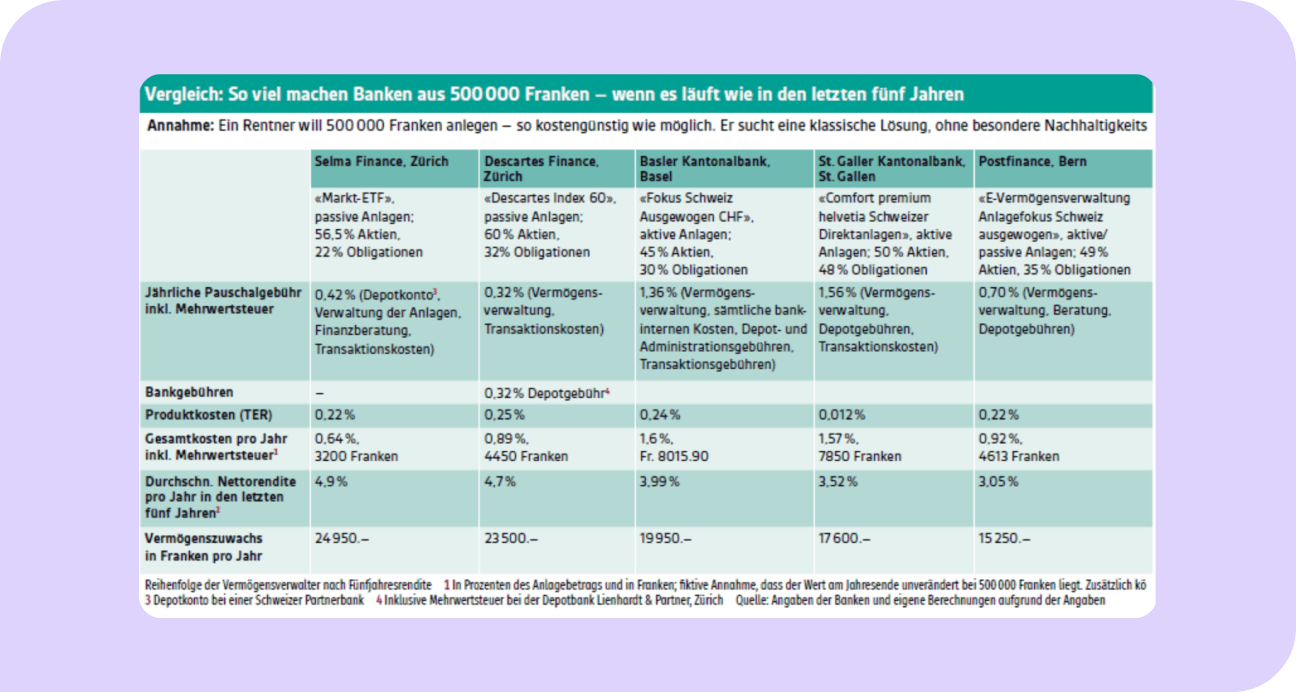
🏆 With a net return of 4.9% and total annual costs of just 0.64%, Selma Finance achieved the highest net return while also having the lowest overall costs of all providers included in the comparison.
Source: Excerpt from K-Geld, February 2026: “Den Altersbatzen nicht der erstbesten Bank überlassen” – including provider comparison
Keep in mind
CHF 500,000 is simply the example used in the comparison. The impact of costs and returns follows the same logic — whether you start with CHF 5,000, CHF 50,000 or CHF 500,000.

The key question: who invests CHF 500'000 best?
At the heart of the K-Geld comparison is a realistic scenario: an investor withdraws their pension fund assets as a lump sum and invests CHF 500'000.
That’s a substantial amount of money – but by no means unusual when accumulated pension assets are paid out.
In fact, 45% of people in Switzerland take their occupational pension as a lump sum. On average, this amounts to CHF 280'210 – money that often needs to last for 20 years or more.
The goal isn’t to maximise short-term returns, but to invest the money in a predictable and cost-efficient way while keeping risk under control.
After all, investing in retirement is less about speculation and more about financial security and predictability – and this is where the differences between providers become clear.
Keep in mind
CHF 500'000 is simply the example used in this comparison. The impact of fees and returns is always the same – whether you start with CHF 5'000, CHF 50'000 or CHF 500'000.
The providers compared: banks vs. digital wealth managers
To put this scenario into perspective, independent financial magazine K-Geld carried out a direct comparison.
It analysed comparable solutions from leading traditional banks and digital wealth managers in Switzerland that are suitable for investing pension fund assets with a balanced investment approach.
Digital wealth managers
- Selma Finance (Zurich)
- Descartes Finance (Zurich)
Banks
- Zürcher Kantonalbank (Zurich)
- Basler Kantonalbank (Basel)
- St. Galler Kantonalbank (St. Gallen)
- PostFinance (Bern)
- Migros Bank (Zurich)
- Raiffeisen
- Bank Valiant (Bern)
- Banque Cantonale Vaudoise (Lausanne)
Keep in mind
The comparison included leading Swiss providers offering comparable solutions suitable for the scenario described above.
The criteria: how the comparison was set up
To make the results meaningful, all providers were assessed under the same conditions: an investment amount of CHF 500'000, a balanced risk profile and a focus on Swiss investments.
Different product names or packaging didn’t matter. What counted was how fees, investment strategy and portfolio structure affected the long-term result.
Keep in mind
Since nobody can predict the future, the comparison used the average returns of the previous five years. This makes it possible to compare providers retrospectively under the same conditions.
The results: which Swiss wealth manager came out on top?
Providers were ranked based on total annual costs, average net returns and the resulting annual increase in wealth on an investment of CHF 500'000.
🏆 #1: Selma Finance
- Total annual costs: 0.64%
- Average net return: 4.9%
- Annual increase in wealth: CHF 24'950
🥈 #2: Descartes Finance
- Total annual costs: 0.89% (CHF 4'450)
- Average net return: 4.7%
- Annual increase in wealth: CHF 23'500
🥉 #3: Basler Kantonalbank
- Total annual costs: 1.60% (CHF 8'016)
- Average net return: 3.99%
- Annual increase in wealth: CHF 19'950
#4: St. Galler Kantonalbank
- Total annual costs: 1.57% (CHF 7'850)
- Average net return: 3.52%
- Annual increase in wealth: CHF 17'600
#5: PostFinance
- Total annual costs: 0.92% (CHF 4'613)
- Average net return: 3.05%
- Annual increase in wealth: CHF 15'250
#6: Banque Cantonale Vaudoise
- Total annual costs: 2.17% (CHF 10'886)
- Average net return: 2.75%
- Annual increase in wealth: CHF 13'750
#7: Bank Valiant
- Total annual costs: 1.68% (CHF 8'423)
- Average net return: 2.43%
- Annual increase in wealth: CHF 12'150
#8: Migros Bank
- Total annual costs: 1.32% (CHF 6'623)
- Average net return: 2.2%
- Annual increase in wealth: CHF 11'000
#9: Raiffeisen
- Total annual costs: 1.45% (CHF 7'256)
- Average net return: 2.2%
- Annual increase in wealth: CHF 11'000
#10: Zürcher Kantonalbank
- Total annual costs: 1.50% (CHF 7'500)
- Average net return: 1.67%
- Annual increase in wealth: CHF 8'350
Source: 2026 comparison: Swiss wealth managers vs. banks
The key takeaways: what the comparison shows
The comparison clearly shows just how much fees and net returns can affect the outcome.
Under exactly the same starting conditions, there is a difference of more than CHF 16'000 per year between the provider ranked first and the provider ranked tenth.
There are three key takeaways:
- Always pay attention to fees
Even differences of just a few tenths of a percentage point can have a noticeable impact year after year when larger sums are invested. - Net return matters – not gross return
What matters isn’t simply how much your investments earn, but how much is actually left after all costs have been deducted. - Comparing providers matters even more in retirement
Investing your pension fund assets is a long-term decision. Small differences can add up to substantial amounts over the years.
You can read the complete K-Geld comparison of Swiss wealth managers and banks in the original article.
Why Selma Finance ranked #1
The result of the K-Geld comparison isn’t a coincidence.
Selma follows a clear principle: independent investing, transparent fees and no conflicts of interest – with one goal in mind: investing clients’ money in the way that best suits them.
And Selma didn’t just rank #1 for net returns in the 2026 K-Geld comparison. It also ranked #1 for customer satisfaction among Swiss digital providers in the hypt Report 2026.
That shows that the two go hand in hand.
- No in-house funds.
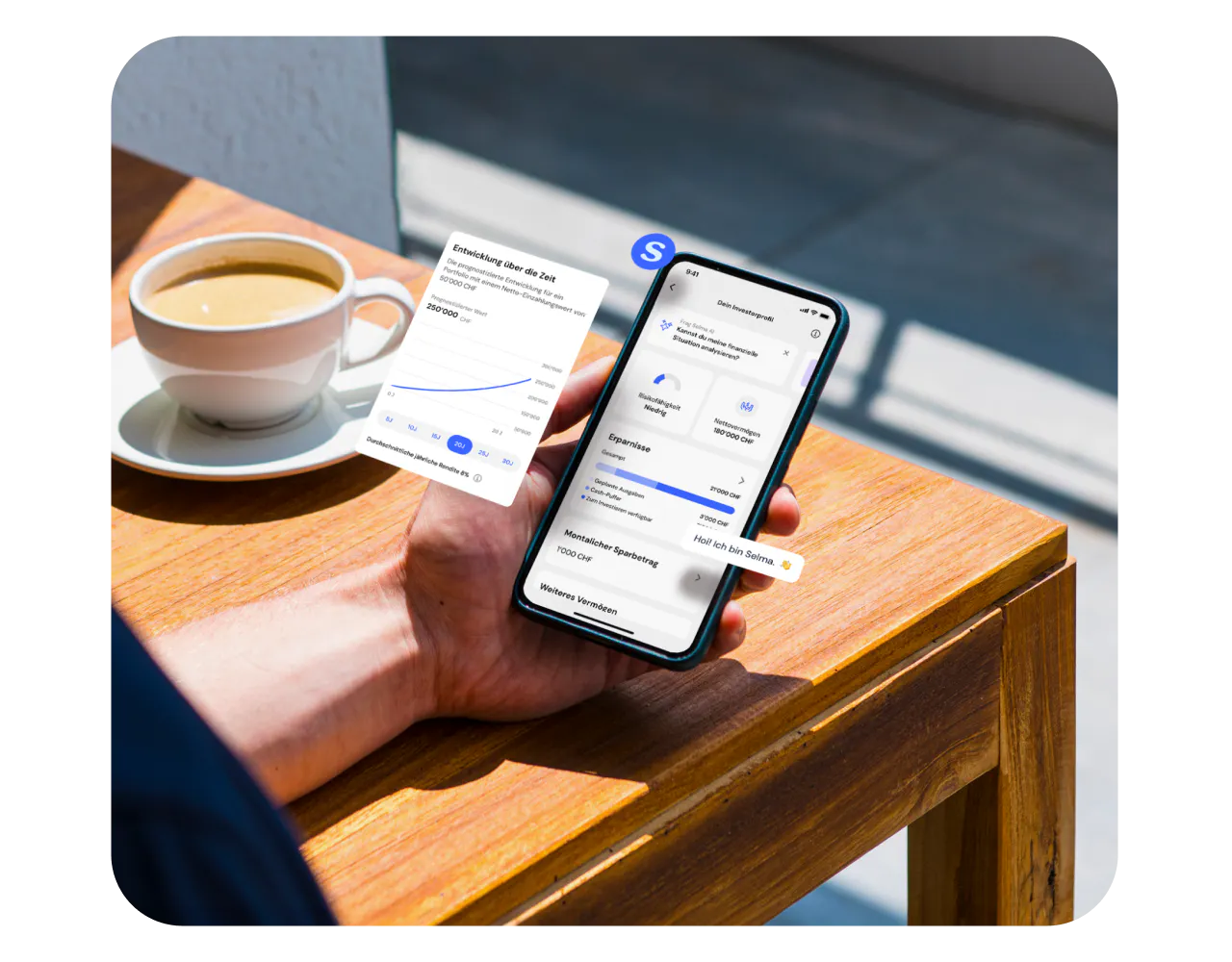
Selma invests exclusively in broadly diversified ETFs. No proprietary products and no hidden fund-level margins. What you see is what you pay – total annual costs of 0.64%, nothing more. - Automatic rebalancing.
Markets move and portfolios drift over time. Selma automatically adjusts your investments to keep your portfolio aligned with your chosen level of risk – without you having to step in or constantly watch the markets. - Pension Mode.
If you’re retired or approaching retirement, your needs are different from those of someone with a 30-year investment horizon. Selma takes this into account and automatically adjusts your strategy: more Swiss investments, lower risk – and, if you want, monthly withdrawals paid directly into your bank account, giving you predictable access to your invested capital. - Personal advice whenever you need it.
Selma is digital, but there are real people behind it. Whether you need help before getting started, have a question along the way or simply want some reassurance, Selma’s team of experts is always available – through the app or in a personal conversation.
How to get started with Selma
Selma Finance is a FINMA-regulated digital wealth manager already trusted by more than 16'000 people in Switzerland.
You can get started entirely online – without visiting a bank or dealing with paperwork.
- Tell Selma about your situation.
In the app, you answer a few short questions about your financial situation, goals and investment horizon. It only takes a few minutes. - Selma creates your personal investment plan.
Based on your answers, Selma creates a broadly diversified ETF portfolio tailored to your goals and risk profile. You can take your time reviewing everything and check your portfolio in full before investing a single franc. - Open your account online.
When you’re ready, you can open your account directly in the app – with no paperwork and no bank appointment, in just a few minutes. - Selma manages everything for you.
Portfolio adjustments, rebalancing and changes in response to market conditions are all handled automatically by Selma. You can keep track of everything in the app at any time, without having to manage it yourself.
And if you have questions – before you start or at any point later on – Selma’s team of experts is there to help personally.
New clients can also book a free financial analysis: a conversation designed to help you understand what actually makes sense for your individual situation.

Niklas Linser
Niklas is taking care of Selma's digital marketing channels. He is an expert in communication, holds a degree in international economics and is way too passionate about. 🎾
LinkedIn